Robot companies are the new tech darlings fueling San Francisco's real estate boom
Photo by Simon Kadula on Unsplash
While everyone’s been obsessing over ChatGPT and large language models, something bigger is quietly reshaping San Francisco’s commercial real estate market: the robotics boom. Companies are racing to bring AI out of the digital realm and into the physical world, and they’re snapping up office space across the city faster than you can say “autonomous warehouse”.
The shift is real and measurable. Physical Intelligence just leased 60,000 square feet at 808 Brannan Street, while Bedrock Robotics claimed around 35,000 square feet at 799 Market Street. Even Jeff Bezos is getting in on the action with his stealth startup Project Prometheus, which is hunting for 60,000 to 100,000 square feet of flexible office and industrial space in San Francisco.
According to real estate research firm JLL, this isn’t just hype. Robotics and drone companies in the Bay Area occupied less than half a million square feet in 2020. By 2025, that number exploded to over 7.6 million square feet, with projections estimating 1.5 million square feet in leasing activity this year alone. About half of the 96 AI robotics firms JLL tracks are based right here in San Francisco, riding the wave of foundational model companies like OpenAI and Anthropic.
The money backing these ventures is staggering. Over the last decade, robotics investment has skyrocketed from $272 million to over $20.6 billion annually. The Bay Area is leading the charge, having received more than $11.8 billion in AI robotics funding since 2020, nearly 30 percent more than Los Angeles, which came in second with $8.8 billion. New York, despite being America’s financial capital, only saw $1.59 billion flow to AI robotics companies.
Venture capital is increasingly bullish on AI-powered robotics specifically. In 2022, only half of robotics investment dollars went to AI firms. By last year, that jumped to over 62 percent. The trend reflects investor confidence that the next wave of technological disruption will come from robots that can actually do things in the real world.
Of course, not every bet will pay off. Monarch Tractor, which raised over $240 million, collapsed last month after abandoning its Livermore headquarters and laying off all employees. Setbacks like that are just part of the game for venture investors willing to take risks on emerging technologies.
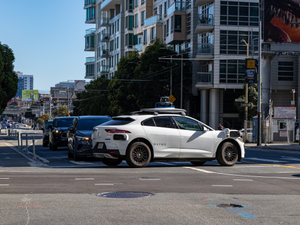
Waymo’s expansion through San Francisco has been the most visible sign of this robotics revolution, but it’s far from alone. As these companies scale up and hardware development requires increasingly specialized infrastructure and real estate, expect the competition for office and industrial space to intensify. The chatbots have had their moment in the spotlight. The robots are here now.
AUTHOR: cgp
SOURCE: SF Standard