Google's Pixel 10a Finally Ditches the Camera Bump, and Honestly, It's Kind of Perfect
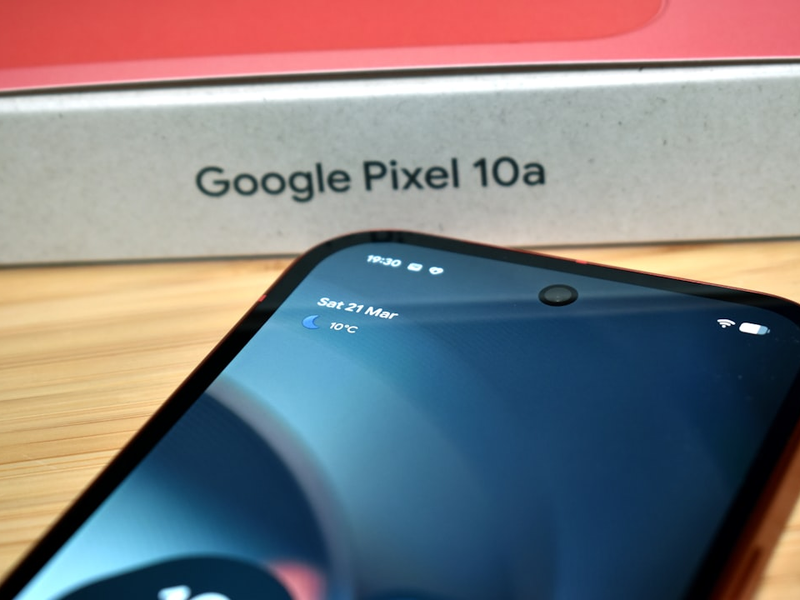
Photo by Gavin Phillips on Unsplash
Google just did something that most smartphone makers have been too afraid to do: they completely removed the camera bump from the Pixel 10a. After years of watching companies pile on bigger and bulkier camera modules, it’s refreshing to see a phone that actually lies flat on a table without wobbling around like a broken chair.
The flat design might seem like a minor thing, but it genuinely improves everyday usability. Beyond that design win, the Pixel 10a stays pretty true to what made the previous generation solid, a reliable, affordable smartphone that doesn’t make you want to take out a second mortgage. You get a 6.3-inch display that’s now much brighter at 3,000 nits, which means scrolling through your feed in bright sunlight won’t feel like squinting at an abstract painting. The screen can hit 120Hz refresh rates, though it comes set to 60Hz, so you’ll need to manually crank it up in settings.
Here’s where Google made the smart trade-off: the 10a has a plastic back instead of fancy glass, but it comes with a bigger 5,100 mAh battery compared to the standard Pixel 10’s 4,970 mAh. The battery easily gets you through a full day of regular usage, scrolling, video watching, and some light gaming. Charging is faster too, you’re getting 30W through USB-C and 10W wireless charging, which beats last year’s 23W and 7.5W speeds.
The camera setup is straightforward: 48-megapixel main sensor paired with a 13-megapixel ultra-wide. It’s the same combo as the Pixel 9a, and honestly, it does the job. The main camera handles low-light situations like a champ, though the ultra-wide loses some detail and doesn’t have autofocus. You do get helpful AI features like Camera Coach to guide your framing and Auto Best Take to merge photos for the perfect group shot.
One significant limitation: the Pixel 10a uses last year’s Tensor G4 chip, so it doesn’t support the updated Gemini Nano model. This means you’ll miss out on features like notification summaries, the screenshot app, and on-device call translation. These AI features work on the flagship Pixel 10, but they’re locked behind that processor difference.
At $499, the Pixel 10a delivers solid value with its flat design, reliable performance, and strong battery life. However, if you already have a Pixel 9a, there’s honestly no compelling reason to upgrade. Plus, the Nothing 4a Pro matches the price but offers a bigger brighter screen, a better processor, a telephoto lens, and blazingly fast 50W charging. Still, if you’re looking for a dependable budget phone that doesn’t pretend to be something it’s not, the Pixel 10a is worth serious consideration. And that flat back? Chef’s kiss.
AUTHOR: mei
SOURCE: TechCrunch